
Social media is now customer service: why unanswered comments are the new bad review
For a growing share of consumers, social is the first support channel. Brands still treating 24/7 monitoring as PR insurance are running a support queue with the lights off.
A shift has been underway for a while, and it is now impossible to ignore. For a growing share of consumers — and for almost all of the ones under 35 — social platforms are the first place they go when something goes wrong. Not the phone line. Not the support email. A comment on the latest post, a DM to the brand handle, a public reply that other customers can see.
That changes what monitoring is. It stops being marketing insurance and starts being customer service infrastructure. Brands still treating it as the former are already exposed.
What has actually changed
The behaviour is not entirely new. What is new is the scale and the expectation that comes with it.
- Public is the default channel. A customer with a broken order, a billing question, or a store complaint will very often try the brand's Instagram or Facebook before they try anything else. They expect a response, and they expect other people to see it.
- The clock has tightened. The tolerable wait for a reply on social is measured in hours, not days. Overnight silence used to be normal. It is now noticed and, increasingly, screenshotted.
- Unanswered comments read as a review. A thread of unanswered questions and complaints underneath a post is, functionally, a bad review. It signals that the brand either is not listening or does not care to respond. Other prospective customers scrolling past absorb that instantly.
The knock-on effect is that a brand's public social presence is now doing work that used to belong entirely to a contact centre. If nobody is staffing that work, the brand is running a support channel with the lights off.
Why "marketing extra" is now a liability
For years, social was treated as an outbound function. Post the campaign, run the engagement, watch the sentiment during a launch. Community management was a bonus, often part-time, often bundled into someone's marketing role.
That framing quietly stopped matching reality. The consequences look like this:
- A customer complaint sits under a post for three days. By day four, five more customers have piled on with similar issues. By day five, a journalist has noticed.
- A DM asking a genuine pre-purchase question gets no reply. The prospect buys from a competitor whose team answered in fifteen minutes.
- A regulated brand receives a comment that meets the threshold for a formal complaint under industry rules. Nobody sees it in time. The regulator eventually does.
None of these are marketing failures in the traditional sense. They are service failures playing out on a marketing surface, and the operational cost lands on customer care, compliance and legal.
The 24/7 point
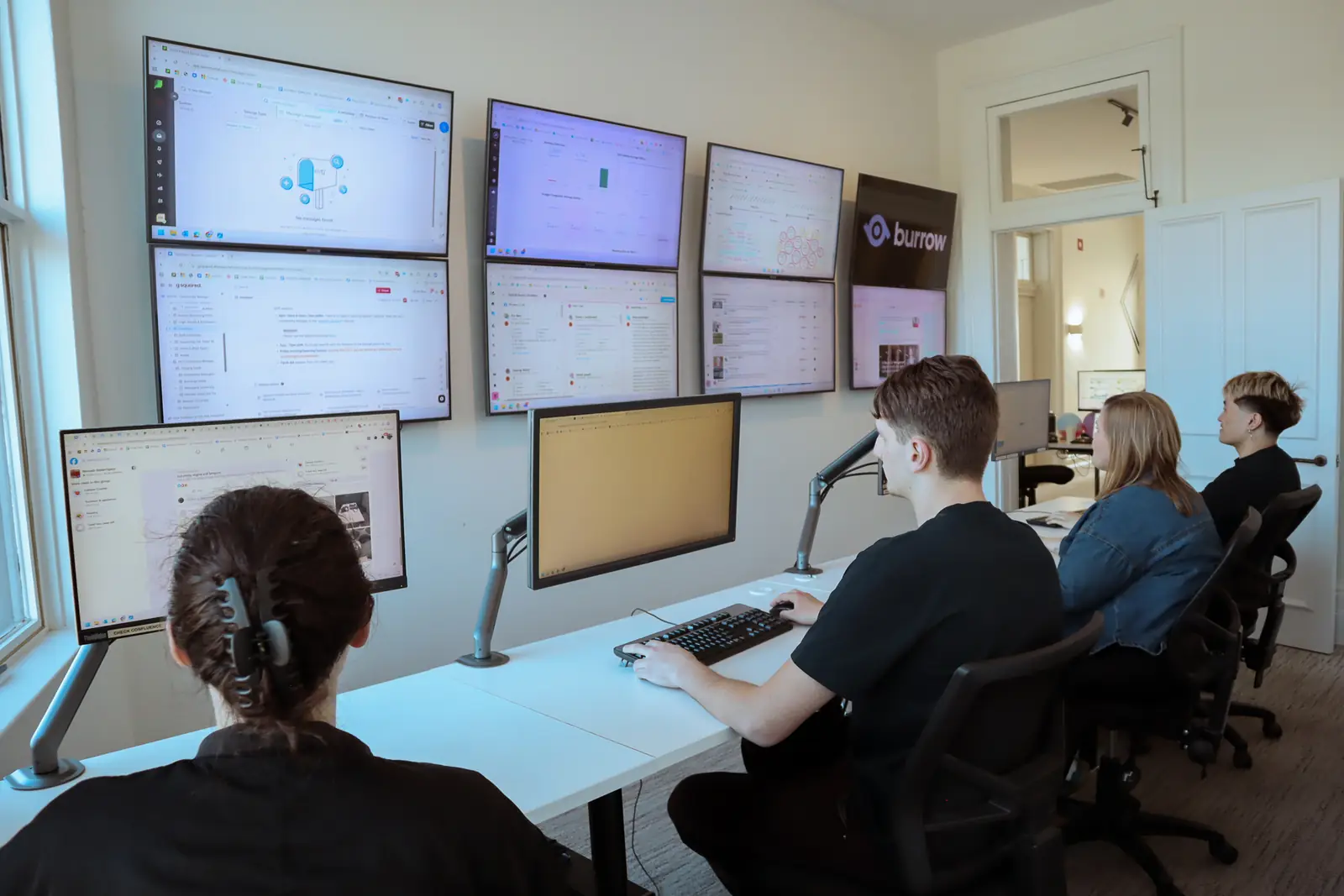
The other thing that has changed is when this happens. Consumers do not restrict their support attempts to business hours. Complaints spike in the evening, over weekends, and during exactly the moments when a brand's internal team is offline. That is when Burrow's command centre floor is busiest, and it is not a coincidence.
A support channel that only operates 9-to-5 in a world where the customer base messages at 10pm on a Sunday is not a support channel. It is a queue that quietly grows overnight.
A short checklist for brands
If you want to know whether your social presence is functioning as customer service infrastructure or as a marketing surface with a service problem, work through these questions honestly.
Coverage
- Is there a real person watching your owned channels outside business hours, on weekends, and on public holidays?
- Do you have a defined response time target for DMs and comments, and do you actually meet it?
- Is there a clear escalation path when something moves from a customer service issue to a reputational or compliance one?
Consistency
- Do responses on social sound like the same brand voice as your other channels?
- Are your community managers trained on the same product, policy and complaint-handling standards as your contact centre team?
- Do repeat issues on social feed back into your product, ops or CX teams, or do they just get closed out?
Visibility
- Can you tell your leadership team, this week, how many customer service issues came in via social and how they were resolved?
- Are you tracking unanswered comments as a service metric, not just a marketing one?
- Do you have a record of what was said, when it was seen, and how it was handled, in case a regulator or a journalist asks?
A brand that can answer yes to most of these is running social as service. A brand that cannot is running a risk it has not fully priced in.
Where Burrow fits
Burrow's 24/7 monitoring exists specifically to close this gap. Trained community managers on the floor of our Australian-based command centre respond in your tone of voice, inside agreed guardrails, and escalate the moment something needs your internal team. In practice that means:
- comments and DMs are answered around the clock, not left overnight
- service issues are resolved or routed, not just flagged
- the pattern of what customers are asking about feeds back to you as intelligence, not just tickets
- your team gets the record they need for compliance, reporting and continuous improvement
Final thought
Social used to be where brands talked. It is now, for a lot of customers, where brands help. Treating it as anything less than that leaves an entire support channel understaffed in full public view. The brands that adjust to this early will look like the ones who cared. The ones that do not will look like the ones who did not answer.